Most LinkedIn Recruiter contracts in Japan are pricing the wrong thing. The seats fund InMail capacity recruiters never send and a search environment they spend twenty-six hours a week inside. Move the search and scout-mail work to Headhunt.AI, hold the InMail volume actually sent unchanged, and two things happen at once. The candidates met per recruiter goes up. The LinkedIn bill comes down. The yen that funded unused capacity now buys ranked Japan-focused candidates instead.
The argument is written for one reader: the person who signs off on the LinkedIn Recruiter contract. Sometimes that is a head of talent at a 200-person SaaS company on a Recruiter Corporate seat pack. Sometimes it is a managing partner at a 30-person agency on an RPS seat pack. The math is the same for both. Redirect the budget. Watch the meetings compound. Renew LinkedIn at a fraction of the seat count.
01Same yen, redirected.
Below are the numbers ESAI Agency reported on its own desk for Q1 2026 — same recruiters, same client mix, same fee structure as prior quarters. The single variable: Headhunt.AI ran the sourcing and scout-mail layer of every search.
ESAI Agency production data, Q1 2026. Comparison is the same recruiters' prior quarters working manually on LinkedIn against the Q1 2026 quarter with Headhunt.AI handling sourcing and scout-mail composition. Not a lab benchmark. Your mileage will depend on market, role mix, and recruiter tenure — but the directional improvement has held across every team we have deployed with.
The same recruiters did not work harder. They stopped working on sourcing.
The credit ROI.
The cascade above is the per-recruiter productivity story. The other production number that matters for the renewal-call math is the unit economics of the credits themselves. Below is the trailing sixteen-week return on every yen of Headhunt.AI credits spent on our own desk — with no human reviewing any candidate before contact and no human editing any scout mail before it sent.
Sixteen weeks of production on the ESAI Agency desk in 2026. Same recruiters as prior periods. 100% of candidates contacted were sourced by Headhunt.AI; 100% of scout mails were composed by Headhunt.AI. Briefing 08 (Trusting the AI) is the deep-dive on this number.
The yen you redirect from LinkedIn seats to Headhunt.AI credits buys more meetings, on a smaller LinkedIn bill, at every team scale we have modeled. The math at every scale is in Section 06.
02The 26 hours a week your recruiters are losing.
A typical Japan recruiting week on LinkedIn-only sourcing gives the recruiter fourteen of forty hours to relationship and closing work. The other twenty-six go to the front of the funnel: Boolean strings, profile reading, longlist building, scout-mail drafting. Hours the seat is gating — that do not produce placements.
| Activity | Before hrs/wk |
After Headhunt.AI hrs/wk |
|---|---|---|
| Sourcing (LinkedIn searches, Boolean strings, profile reading) | ~12 | ~0 |
| Building shortlists (filtering, scoring, cleaning data) | ~8 | ~0 |
| Writing scout mails (one at a time, JP and EN) | ~6 | ~0 |
| Actual recruiting (candidate calls, pitching, closing) | ~14 | 30+ |
Pattern observed across the ESAI Agency desk and dozens of Japan-based LinkedIn Recruiter teams through Q1 2026. The 30+ figure is post-Headhunt.AI on the ESAI desk; hybrid adopters typically land in the 24–28 range.
Same recruiters. Twice the closing hours. That is where the +38% comes from.
03What ¥1 buys on each side.
LinkedIn Recruiter packages a search environment and an InMail allotment together, charges per seat, and lets the bundled InMail capacity expire unused. Headhunt.AI charges per qualified match — one credit equals one Japan-focused candidate that meets the search criteria and scores 50+ on the ESAI Score. The unit of cost is different. The unit of result is different. So is the throughput of yen.
Buys 1,200 InMails for the year (100 per seat per month, pooled). Sits on LinkedIn's search environment. Across typical Japan team usage, ~660 of those InMails expire unused. The seat does not surface candidates beyond what the recruiter's Boolean string returns from the LinkedIn-resident profile pool.
Buys 10,775+ ranked candidates from a 4M+ Japan-focused database. Each carries an ESAI Score, a written fit explanation, and a JP/EN scout mail drafted to the actual profile. Candidates below ESAI 50 are not charged. Credits roll over for the contract year.
The substitution is not one-for-one — a LinkedIn seat does include the InMail channel, and Headhunt.AI does not. The argument here is not that Headhunt.AI replaces every function of a LinkedIn seat. It is that the search-and-scout-mail layer of the seat, which is what consumes most of the recruiter's hours and most of the yen, runs better per result on a per-match meter than on a per-seat fee.
04¥100,000 in. ¥1,720,788 out.
Five measured steps connect a credit purchase to expected revenue. Each step is a production number from the ESAI Agency 2026 cohort — not a projection. The math compounds. The headline figure surprises people on first read.
-
Spend ¥100,000 on Headhunt.AI credits.
The system contacts roughly 1,570 candidates with a personalized three-message scout sequence, auto-stopping on reply. Recruiter time on this layer: zero.
-
Receive ~50 replies at the 3.13% production reply rate.
Roughly fifty replies land in the recruiter team's inbox. The reply rate is what the autonomous system produces on cold-to-warm Japan-focused outreach with no human review.
-
Convert ~16 of those replies to qualified meetings.
The reply-to-meeting conversion rate is 32.57% — the human-leverage part of the funnel. Roughly sixteen meetings reach the calendar.
-
Each meeting carries ¥107,676 of expected revenue.
From the 2026 unit economics: ¥4,266,675 average placement fee divided by 39.625 meetings per placement.
-
Total expected revenue: ¥1,720,788.
16 meetings × ¥107,676. From a ¥100,000 credit spend with no recruiter hours added on top. A 17.2× return on the credit input.
Every part of sourcing rolls up to one question. What does it cost to produce a qualified meeting? The answer, in production, is roughly ¥6,250 in credits.
05What the LinkedIn line is actually buying.
Canceling LinkedIn is not the argument. Right-sizing it is. To do that, the budget-holder needs to see what the bundled seat fee actually buys. Three things sit inside it. Only one of them tracks to recruiter output.
Typical Japan team · 10 RPS seats · 12-month contract. Drawn from sales conversations with dozens of Japan-based companies and agencies on RPS or Recruiter Corporate through Q1 2026. The pattern is consistent across both contract types: utilization runs in the 35–55% range, capped by the throughput of LinkedIn-resident sourcing and not by InMail availability.
What the seat fee actually bundles.
-
The InMail allotment — 100/seat/month on RPS, 150 on Recruiter Corporate.
Tracks to outreach volume. Useful, but typically half-used. Carry-forward caps at four months; unused credits expire at cancellation with no refund.
-
Access to LinkedIn's search environment.
The part the seat is really gating. Used heavily — 12–20 hours of recruiter time per week per seat — but it does not surface candidates beyond what the Boolean string returns from the platform-resident pool.
-
The brand layer on InMail itself.
Real, narrow, valuable. LinkedIn's inbox is a higher-trust channel than cold email for the senior named-candidate moments. This is the layer worth keeping seats for — just not at the count required when the same seats also have to fund the search work.
The pricing ladder.
LinkedIn does not publish a public price list for Recruiter Professional Services (RPS) or for Recruiter Corporate. The pricing below is the FY 2026 RPS tier table LinkedIn shares with customers up for renewal. The figures have been confirmed directly with LinkedIn.
| Tier | RPS USD / seat / year |
RPS+ USD / seat / year |
|---|---|---|
| 1–2 | $6,225 | $8,100 |
| 3–5 | $4,975 (20% off) | $6,450 (20% off) |
| 6–10 | $4,375 (30% off) | $5,700 (30% off) |
| 11+ | $3,850 (39% off) | $5,000 (39% off) |
| 21–50 | $3,575 (43% off) | $4,650 (43% off) |
| 51+ | $3,325 (47% off) | $4,300 (47% off) |
LinkedIn FY26 RPS pricing schedule, in effect from July 2025. RPS+ is LinkedIn's newer tier with a higher InMail allotment. Recruiter Corporate (the in-house product) is priced separately — reported Q1 2026 Corporate seat pricing lands around US$10,800–US$15,000 per seat per year. The 47% discount at the 51-plus tier is what LinkedIn itself thinks the marginal seat costs to deliver.
From the buyer's side, the discount ladder means the marginal seat at scale is mostly bundled InMail — the same conclusion the utilization data above reaches from the other direction. From LinkedIn's side, the 47% Tier-6 discount is the platform's own admission of what the seat costs to deliver once the search-environment work is amortised across a larger contract.
The seat fee bundles search and outreach. Search runs better on a meter.
The renewal letter arrives on schedule.
Anyone who has held a LinkedIn Recruiter contract for more than three years has received some version of the renewal letter. The arrival is predictable. The math is predictable. The pattern — not any single rate increase — is the structural argument for diversifying part of the budget off the platform.
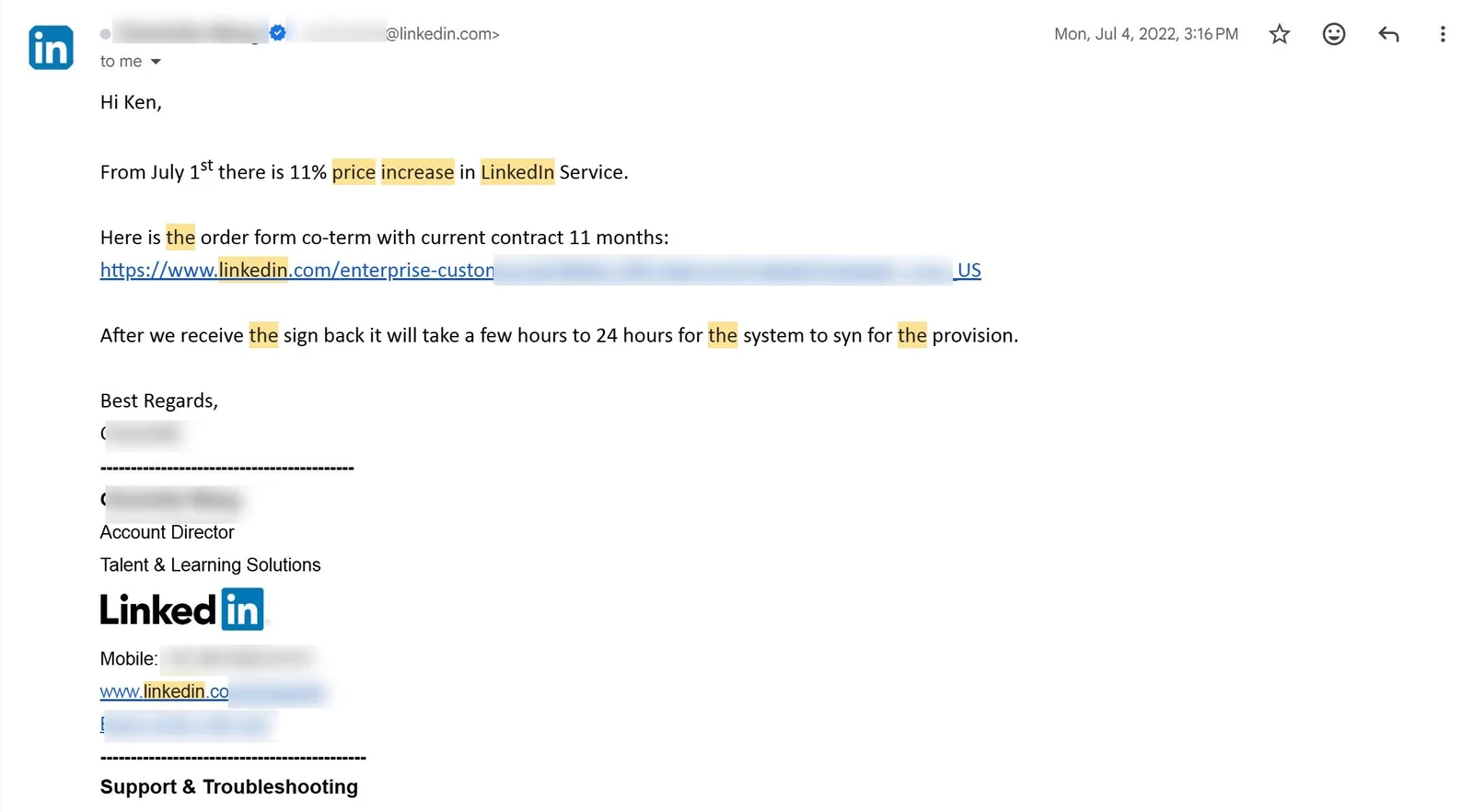
The 2022 letter: an 11% headline rate increase on the LinkedIn Service contract, ten months into a new contract. The actual seat-line increase depends on the existing tier and the negotiation that follows. Most teams accept some version of the headline rate because the seat is operationally embedded by the time the letter arrives.
The headline rate moves on a schedule. So does the contract size. So does the negotiation strength of a single-platform budget.
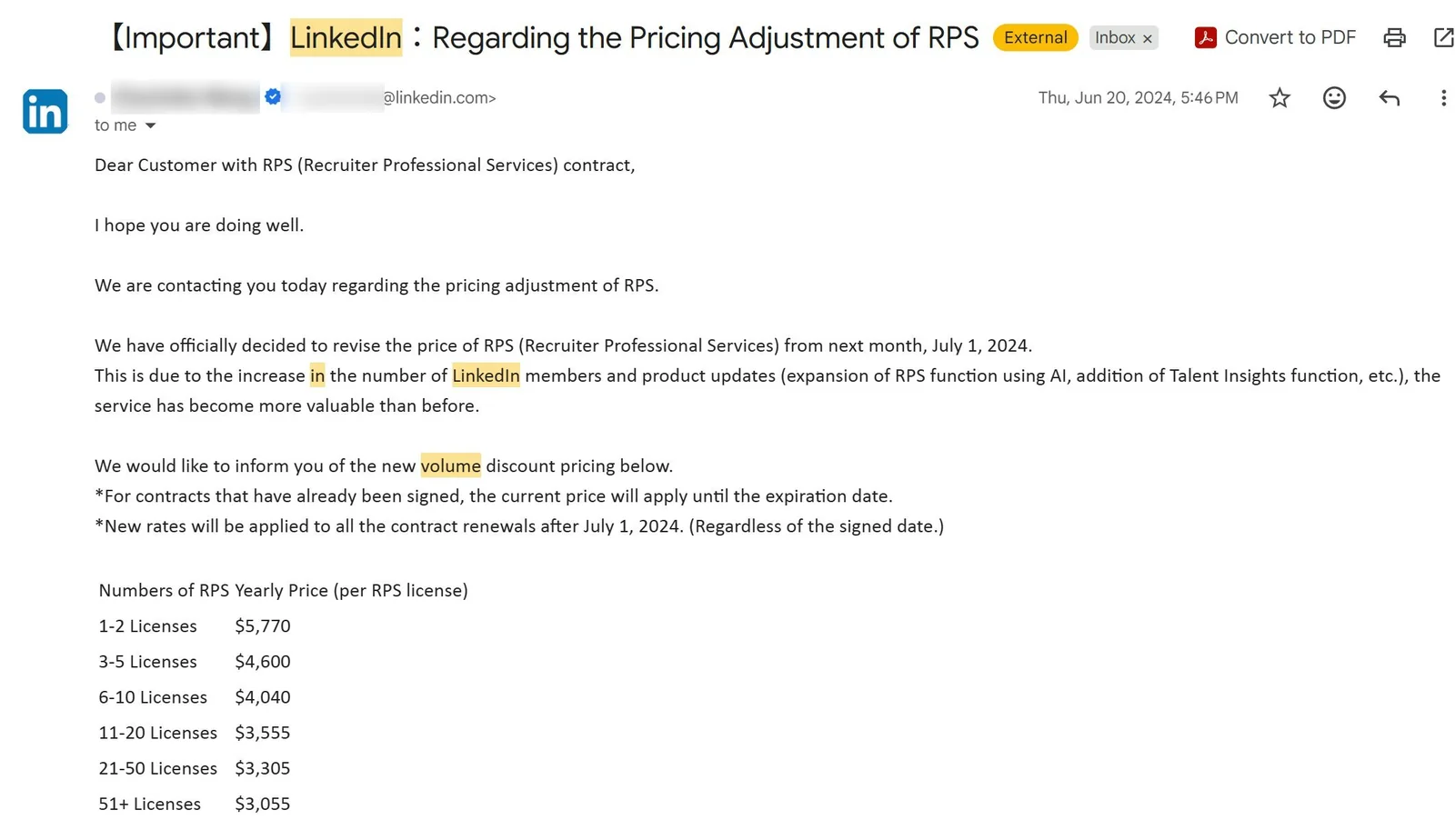
Two years later, same account, same product, the letter arrives again. The 2024 letter cites "expansion of RPS function using AI, addition of Talent Insights function" as rationale for revising the price of RPS. New rates applied to all renewals after July 1, 2024 — regardless of contract date. The rationale is the standard pattern. The third letter, in another two years, will arrive again.
None of this is unique to LinkedIn. Any single-vendor budget line on a multi-year contract carries the same exposure — the vendor sets the headline rate, the customer absorbs what the operational dependency makes hard to refuse. The mitigation is not negotiation. It is a smaller line.
Diversification is what changes the negotiation. A single-platform line takes the engine's yearly output, in full.
06The math, at every scale.
Six worked scenarios. Three RPS team sizes, two Recruiter Corporate team sizes, and a "90% cut" aspirational path. Productivity is modeled at a conservative 5× ROI on credits, well below our own desk's 17.2×. For RPS, that uplift is incremental placement revenue. For Recruiter Corporate, the same yen is agency fees avoided — hires made internally that would otherwise have gone to external search. The Database Tax math from Briefing 05 shows the same redeployment dynamic at the per-placement-fee level.
| Team profile | LinkedIn now | Right-sized | + Headhunt.AI | Tool cash Δ | Productivity | Y1 P&L |
|---|---|---|---|---|---|---|
| 5 RPS seats → 2 | ¥3.91M | ¥1.95M | ¥5.10M Pro | −¥3.15M | +¥25.5M | +¥22.4M |
| 10 RPS seats → 4 | ¥6.87M | ¥3.12M | ¥5.10M Pro | −¥1.36M | +¥25.5M | +¥24.1M |
| 15 RPS seats → 6 | ¥9.07M | ¥4.12M | ¥9.18M Ent | −¥4.23M | +¥45.9M | +¥41.7M |
| 20 RPS seats → 8 | ¥12.09M | ¥5.50M | ¥9.18M Ent | −¥2.59M | +¥45.9M | +¥43.3M |
| 10 Corporate seats → 4 | ¥18.84M | ¥7.54M | ¥5.10M Pro | +¥6.20M | +¥25.5M | +¥31.7M |
| 20 Corporate seats → 8 | ¥37.68M | ¥15.07M | ¥9.18M Ent | +¥13.43M | +¥45.9M | +¥59.3M |
| 90% cut path · 20 RPS → 2 | ¥12.09M | ¥1.95M | ¥9.18M Ent | +¥0.95M | +¥45.9M | +¥46.9M |
LinkedIn pricing at FY 2026 RPS list (confirmed with LinkedIn); Recruiter Corporate at the US$12,000/seat market midpoint. FX rate: ¥157/USD. Headhunt.AI Pro Annual = ¥5.1M/yr (72K credits); Enterprise = ¥9.18M/yr (144K credits). Productivity column applies a conservative 5× ROI to the credit input — well below the 17.2× ESAI Agency produced under fully autonomous operation (Briefing 08). Y1 P&L sums LinkedIn savings, Headhunt.AI cost, and conservative productivity. Year 2+ is structurally stronger.
One worked example.
One scenario walked line by line. A ten-recruiter, ten-seat RPS agency — the most common buyer profile in the Japan agency market — with the same client portfolio, same fee structure, same recruiter team. The only variable changing is whether the search-and-scout-mail layer of the work happens inside LinkedIn or inside Headhunt.AI.
| Line item | ¥ impact |
|---|---|
| LinkedIn before — 10 seats, 6–10 tier ($4,375 / seat) | −6,868,750 |
| LinkedIn after — 4 seats, 3–5 tier ($4,975 / seat) | −3,124,300 |
| LinkedIn-line saving | +3,744,450 |
| Headhunt.AI Pro Annual — 6,000 credits/month × 12 | −5,100,000 |
| Net cash on tool budget | −1,355,550 |
| Productivity uplift — conservative 5× ROI on ¥5.1M credits | +25,500,000 |
| Year-1 P&L impact | +¥24,144,450 |
On a 10-seat RPS team, the LinkedIn-line saving (¥3.74M) covers most of the Headhunt.AI Pro Annual cost (¥5.1M). The ¥1.36M cash difference is what funds a productivity uplift estimated at ¥25.5M of expected revenue at the conservative 5× rate — or ¥87.7M at our own desk's 17.2× production rate. The right question is not whether the tool budget goes up by ¥1.36M in Year 1. It is what ¥1.36M of net new tool spend produces in incremental closings. The model assumes it produces a lot. The production data confirms it does.
The yen redirected from LinkedIn to Headhunt.AI does not disappear. It buys candidates instead of capacity.
07Built in Japan. Filed under Japanese law.
Several global AI sourcing tools sell into Japan at sticker prices well under Headhunt.AI's. The comparison skips what matters most for any team running recruiting in Japan: what the platform is doing, under Japanese law, when it hands a recruiter a candidate list. Briefing 07 (Is your AI & sourcing stack illegal in Japan?) walks the regulatory frame in depth; the short version follows.
Filed with MHLW. Compliant under the 2022 amendment.
Headhunt.AI's operating entity, ExecutiveSearch.AI K.K., is filed with Japan's Ministry of Health, Labour and Welfare as a 第4号特定募集情報等提供事業者 under the amended 職業安定法 (Employment Security Act). Operating without that filing has been a criminal offense under Article 65(7) since the October 2022 amendment. As of MHLW's March 2026 figures, six services in the country are filed in the 第4号 category. Headhunt.AI is one of them.
Never touches LinkedIn directly. No plugin. No script. No overlay.
Several of the cheaper global tools inject a browser plugin or run a script inside a logged-in LinkedIn session. Under LinkedIn's User Agreement Section 8.2 that is a terms-of-service violation; under APPI Article 20 it is unlikely to qualify as "fair means." The exposure sits on the customer, not just the vendor. Headhunt.AI does not touch LinkedIn at any point. The 4M+ profile base is sourced primarily from public LinkedIn data, with public signals from X (formerly Twitter), GitHub, Facebook, and Instagram layered in where candidates have visible activity there.
Native Japanese scout mail, validated in production.
The bilingual engine writes business Japanese to a native register. Production reply rate on autonomous, unedited Japanese scout mail is 3.13% — well above the 0.3–0.8% floor for templated outreach in either language.
08Common objections we hear.
Seven questions from peer talent leaders and agency principals over the last twelve months. Each gets a straight answer, not a deflection.
"The productivity numbers look great, but they're from your own desk. How do I know they'll repeat on mine?"
Fair pushback. The directional improvement has held across every Japan team we have deployed with, but role mix, recruiter tenure, and client portfolio all matter. The honest test is the silent pilot in Section 11 of Briefing 08: put Headhunt.AI behind one billing recruiter for six weeks, hold everything else constant, and measure the meeting count. If the count moves, you have your answer for that recruiter. If it does not, you also have your answer — and nobody on the team had to be convinced of anything.
"Our recruiters need LinkedIn. We can't risk losing access during a hot quarter."
Agreed — that is not what we are recommending. The argument is right-sizing the seat count, not canceling the contract. Most of these conversations end with the team renewing on the same product, with the same InMail allotment per seat, and a smaller number of seats. LinkedIn's account team does not want to lose the relationship; they renew at the lower tier rather than let the contract walk. Sequence matters: redirect the search work to Headhunt.AI first, then negotiate.
"Recruiters won't change how they work. They like what they have."
Recruiters resist tools that add work. Headhunt.AI subtracts work — the Boolean iteration, the longlist building, the scout-mail drafting in two languages. The workflow change is the recruiter pasting a JD instead of writing a search string. After the first week, the resistance we see runs the other way. The InMail workflow they already know keeps running for the messages they genuinely want to write by hand.
"The 17.2× ROI assumes hands-off operation. We won't run hands-off in year one."
Correct. The 17.2× is the base rate on our own desk with no human review. The math in Section 06 uses a conservative 5× ROI to model what hybrid adopters can defensibly underwrite — recruiters using Headhunt.AI for sourcing and scout-mail composition, then sending through their own LinkedIn or CRM infrastructure. Even at 5×, Year-1 P&L impact is +¥22–59M across the scenarios in the table. The 17.2× ceiling exists; the 5× floor is what we underwrote against in this brief.
"If we cancel seats, we lose what's inside them — saved searches, notes, project history."
Partly true. Personal saved searches and recruiter-specific notes leave with the canceled seat. Shared Projects and team Talent Pools stay. The pre-renewal window is the right moment to export anything that matters to your ATS or to Headhunt.AI's workspace. LinkedIn provides CSV export of saved searches and project candidates without friction. The actual data loss is small.
"Some AI sourcing tools cost less than Headhunt.AI. Why pay more?"
Two reasons. First, the cheaper tools mostly work by injecting plugins or running scripts against LinkedIn — a terms-of-service violation on LinkedIn's side and a likely APPI Article 20 problem in Japan. The exposure sits on the buyer. Second, the native-Japanese scout layer is where reply rates in Japan actually pay off. A 0.3% reply rate at half the price is more expensive per qualified meeting than a 3.13% reply rate at full price. The unit you should care about is the meeting, not the seat.
"If this is so good, why haven't peer firms moved already?"
Several have. The ones who moved early are not advertising it — for the same reason no peer agency announces its margin recovery in a press release. The migration is a margin advantage, and margin advantages are not the kind of thing you publish. You hear about it from peer principals at the same maturity stage you are at, in private. By the time the category-wide reset is visible, the budget-holders who moved first are two quarters ahead.
The math is on the buyer's side. The reallocation has to be made by the buyer.
09Seven questions worth asking before renewal.
The right starting question is not "should we keep LinkedIn?" The answer is yes. The right starting question is what your current LinkedIn line is leaving on the table — in meetings, placements, and recruiter hours — and how much of the line could be redirected without changing the InMail volume your team actually sends.
- Do you know how many hours per week each recruiter actually spends closing, vs. on Boolean strings, longlists, and scout-mail drafting? If the answer is "more than half on closing," we have not met that team yet.
- Do you know your team's average monthly InMail use per seat over the last twelve months? Or only over the quarter the LinkedIn renewal slide reported on?
- Do you know your current InMail bucket balance, expressed as a multiple of monthly allotment? Above 1.5×, you're funding capacity already sitting in inventory.
- What share of your LinkedIn-sourced candidates last quarter were found through Boolean search inside the platform vs. surfaced through other tools and worked through LinkedIn only for the InMail?
- If a peer firm announced +38% candidates met per recruiter on a smaller LinkedIn bill tomorrow, what is your concrete response?
- Have you run a structured AI sourcing test on a real open requisition in the last twelve months — or is your view based on vendor demos and conversations with peers?
- If LinkedIn called tomorrow with a renewal quote at the headline price-up rate, could your finance function defend the implied seat count against actual usage and against the productivity each seat is delivering, line by line?
6–7 specifics: The reframe is mostly confirmatory. Run the math anyway — the renewal call goes very differently.
4–5 specifics: Most of the recapturable revenue sits in the productivity layer the audit will surface.
2–3 specifics: The LinkedIn line is being managed without visibility on what each seat is delivering. Probably over-sized.
0–1 specifics: Operating without visibility on a six- or seven-figure annual line. The seat count is whatever LinkedIn last quoted.
10The honest take.
LinkedIn Recruiter is not the problem. The InMail brand layer is genuinely useful for the senior named-candidate moments where it earns its keep. The problem is the pricing model that bundles search and outreach into one seat fee and leaves the bundled half half-used — a gap that costs the buyer in two ways. The unused capacity is the smaller cost. The larger cost is that the search work funded by the seat consumes most of the recruiter's week on a fixed monthly fee, with no compounding throughput.
Redirect the seat-gated search work to Headhunt.AI. Renew LinkedIn at the seat count actually needed for the InMail volume the team genuinely sends. The math at every scale in Section 06 points the same way: the LinkedIn-line saving covers most of the Headhunt.AI cost, and the credit spend produces meetings on top — +¥22–59M of Year-1 P&L impact at the conservative 5× rate. The closing argument is not whether the math works. It is whether the budget-holder runs it before the next renewal call. Once the search work is off the seat, the natural next move is to compound the workspace — every search you run scores and structures candidates into an asset your firm controls. Briefing 06 (Enrich your ATS while you sleep) is the read for what to do with the recovered hours.
These systems are the worst they will ever be today. The pace of improvement in AI is not linear — invest now to stay ahead of your competition, or fall behind.
This is uncomfortable to read. It is more uncomfortable to act on. Doing nothing is a decision, the same as any other. It just looks more like the present, which makes it feel safer than it is.