
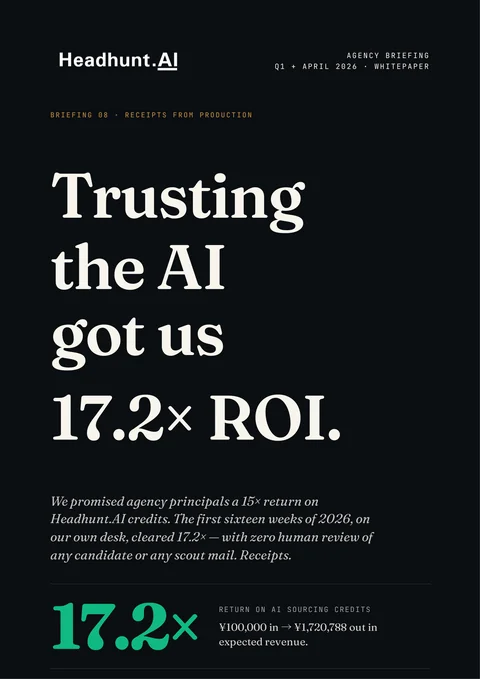
Briefing 01, first hypothesized in January, projected that ¥100,000 of Headhunt.AI credits would convert to roughly fifteen qualified candidate meetings — and from there to about ¥1.5M of expected revenue. A 15× return. The first sixteen weeks of 2026 are now in the books, on our own desk, and the ratio came in above projection.
¥100,000 of credits produced 16 qualified meetings. At our 2026 average placement fee, those meetings carry ¥1,720,788 in expected revenue. That is a 17.2× return on every yen spent on credits.
Sixteen weeks of production at ESAI Agency K.K., 1 January through 30 April 2026. Same recruiters as prior periods. Same fee structure. The variable is that 100% of sourcing ran autonomously — no human reviewed any candidate and no human edited any scout mail.
We projected 15×. The receipts say 17.2×. The recruiters did not work harder; they stopped working on sourcing.
02Hands off the funnel.
Briefing 01 framed Headhunt.AI as a sourcing accelerator. The 2026 production data forces a sharper claim. Across the sixteen-week window, 100% of the candidates this desk contacted were found by Headhunt.AI, and 100% of the scout mails it sent were written by Headhunt.AI — with zero human review of either.
The split is clean. AI, hands off: universe scoring across 4M+ profiles plus your existing ATS, scout mail composition in business Japanese or English, three-message sequencing with auto-stop on reply. Human, where leverage lives: reply triage and meeting confirmation, the candidate meeting itself, client briefing, shortlisting, and closing.
The autonomous block on the left ran for the full sixteen weeks without human edits. The base rate in this brief is what an agency gets when nobody touches the sourcing layer at all.
The point is not that AI helps a recruiter source faster. It is that there are no recruiter hours in the sourcing funnel.
03The funnel, drawn from sixteen weeks of production.
Three numbers describe the full funnel: how many candidates the system contacted, how many replied, and how many of those replies converted into a qualified meeting on the recruiter’s calendar. The shape of the funnel is what produces the 17.2× number.
The 3.13% reply rate is what the autonomous system produces on cold-to-warm Japan-focused outreach with no human review — well above the 0.3–0.8% floor for spammy templated outreach. The 32.57% reply-to-meeting conversion is what the recruiter team produces once a reply lands; that is the human-leverage part of the funnel, and it is healthy.
The 123,675-candidate total was not produced in a single batch. It was produced week-by-week across sixteen weeks of normal operating tempo. Weekly volume rises across the period as the system saturates each role’s reachable universe and rotates onto new searches. The recruiter team did not add hours during the ramp; the lift came from removing sourcing work from the recruiter week, not from doing more of it. Meetings include both first-time candidates and known candidates re-surfaced from our ATS.
Volume is the easy part. The hard part is producing volume the recruiters trust without making them work the front of the funnel.
04The unit economic atom, recalculated.
Briefing 01 anchored on ¥100,000 of expected revenue per qualified meeting — derived from a ¥4M placement fee and 40 meetings per placement. Both inputs have moved slightly. The recalculated number is ¥107,676 per meeting.
Both inputs are measured, not estimated. The placement fee is the trailing 16-week average across closed placements. The 39.625 ratio is the trailing meetings-to-placements count over the same window. Industry benchmark for the ratio is 40; our cohort runs marginally tighter.
The fee shift (¥4M → ¥4,266,675) is a mix effect, not a pricing change. We still charge 30–35% of annual salary on placements; the 2026 cohort skewed slightly higher in salary band, which raised the average. The meetings-to-placement ratio sits inside the normal band of 35 to 50 published in Briefing 01.
Every part of sourcing rolls up to one question. What does it cost to produce a qualified meeting? The answer, in production, is roughly ¥6,250 in credits.
05From ¥100,000 to ¥1,720,788.
Five steps connect a credit purchase to expected revenue. Each step is a measured number from our 2026 production cohort, not a projection. The math compounds, which is why the headline figure surprises people on first read.
-
Spend ¥100,000 on Headhunt.AI credits.
The system contacts roughly 1,570 candidates with a personalized scout sequence — three messages per candidate, auto-stopping on reply. Total cost: ¥100,000. Recruiter time on this layer: zero.
-
Receive ~50 replies at the 3.13% production reply rate.
Roughly fifty replies land in the recruiter team’s inbox over the campaign’s run. The reply rate reflects autonomous outreach with no human review of either the candidate list or the message text.
-
Convert ~16 of those replies to qualified meetings.
The reply-to-meeting conversion rate is 32.57% in our 2026 cohort — the human-leverage part of the funnel. Roughly sixteen meetings reach the calendar.
-
Each meeting carries ¥107,676 of expected revenue.
From the recalculated unit economic atom: ¥4,266,675 average placement fee divided by 39.625 meetings per placement.
-
Total expected revenue: ¥1,720,788.
16 meetings × ¥107,676. From a ¥100,000 credit spend with no human hours added on top. A 17.2× return on the credit input.
The recruiter team did not work the front of this funnel. The numbers are what the autonomous system produced.
06What hands-off frees up.
Briefing 01 measured what consumes a typical recruiter week. 60–70% of the time goes to sourcing and qualification — universe-building, longlist triage, scout drafting, follow-up sequencing, scheduling. Hands-off sourcing removes that block. The hours have to land somewhere.
In our 2026 cohort, those hours land in the only place they can: on the human side of the funnel — the calendar, the conversation, the close. Across the 16-week window, recruiter hours per week stayed flat (about 40 each). Hours allocated to sourcing dropped to roughly 5% — checking the AI’s output and flagging issues. Hours allocated to candidate meetings, client briefings, shortlist construction, and closing rose proportionally. Same recruiters. Same week. Different mix.
This is the answer to the question principals ask first: "If the AI does the sourcing, what do my recruiters do?" They do the work that actually produces revenue. Sourcing has never been the leverage activity. The leverage activity has always been the candidate meeting and the client conversation. Hands-off sourcing is the move that lets recruiters do more of the high-leverage work without working longer hours.
The leverage activity in recruiting is not finding the candidate. It is the conversation that follows. Hands-off sourcing buys back the hours where that conversation happens.
07Where the candidates actually come from.
Two pools feed every search. The agency’s existing ATS, which holds candidates the desk has worked before. And 4M+ Japan-focused profiles on the open web. Headhunt.AI scores both pools against the role’s specific criteria, deduplicates them, and routes a single ranked list. Candidates the recruiter has met before — and built context with — surface as readily as new candidates.
The ATS side: candidates the desk has spoken to before. Imported via CSV today (direct integrations to ATS, CRM, and workflow tools are on the roadmap). No data migration; the ATS stays where it is. Phone numbers, email addresses, and any custom fields the customer chooses to include in the upload flow straight onto the result so recruiters can act immediately.
And here is the part that compounds. Most agency ATS records are years stale. The candidate’s title is from when you spoke to them. The company is from when you spoke to them. By the time a relevant role opens for that candidate, half of what you have on file is wrong. Headhunt.AI fixes this as a side effect of running. Every time the system scores an ATS candidate against a role, it checks the candidate’s record against the live 4M-profile database. New title, new employer, new tenure pattern, new visible signals — the ATS record is updated in place.
The mechanic by which ATS records are refreshed as a side effect of running searches — and how that asset compounds over time — is the subject of the companion briefing 05, "Enrich your ATS."
We score your ATS alongside the open web — and return one list containing both.
08The base rate is what you get without trying.
17.2× is the production base rate. It is what the system produces when no human reviews any candidate before contact and no human edits any scout mail before it sends. The base rate exists so that any agency adopting Headhunt.AI knows the floor.
The ceiling is higher. Every scout mail in Headhunt.AI is fully editable before sending. Every candidate in the ranked list can be excluded with one click. Recruiters who selectively override — improving message tone for a senior candidate, removing a known wrong-fit profile — produce results above the base rate. We see this on our own desk in narrower role pockets where domain knowledge concentrates.
The 17.2× number is not the maximum. It is what the autonomous system produces with the humans pulled out of the funnel. Recruiters who choose to spend 10 minutes per role tightening targeting or rewriting one or two scout mails for senior candidates can push the number higher. We publish the base rate because that is what an agency can rely on; the ceiling depends on how the agency uses the override.
Hands-off is the floor, not the ceiling. The 17.2× is what an agency gets without trying. What it gets when the recruiters apply judgment is higher.
09Common pushback.
Seven questions principals ask once they hear "100% AI sourcing, zero human review." Each gets a direct answer.
"100% AI-written scout mails sound like spam waiting to happen."
Fair pushback. The reply rate is the proof. 3.13% on cold-to-warm autonomous outreach in Japan is well above the floor for spammy templated outreach, which lives at 0.3–0.8%. Recipients reply because the messages reference each candidate’s actual profile, current role, and visible career signals — not because the messages are short or aggressive. The composition model was trained on what worked across our own desk for years before it was made hands-off.
"If the AI is wrong about a candidate, nobody catches it before send."
True at the candidate level — and that is by design at the base rate. But the composition is per-candidate, not per-template. If the system has bad evidence, the message is generic, the reply does not come, no harm is done. The cost of a wrong candidate that nobody opens is one credit. The cost of a senior recruiter spending an hour qualifying that same candidate is one recruiter-hour. The economics favor letting the autonomous layer run.
"Our brand voice cannot tolerate AI-written messages."
Sometimes true at the senior end of the market. The override exists for this. Most agencies enable hands-off for their core mid-market role volume — where the math works decisively — and hold human review for senior or named-account roles. The base rate does not require uniform adoption.
"Reply rate is one thing. Are these meetings actually qualified?"
32.57% reply-to-meeting conversion is the answer. Reply rates are easy to manipulate; meeting conversion is not. A reply that converts to a calendar event with a real candidate at the right level is a meeting. The 1,260 meetings on our desk produced placements at the standard 39.625-to-1 ratio — the meetings are qualified at the same standard our recruiters apply to manually-sourced candidates.
"We already have an ATS. We do not need another database."
You do not get another database. Headhunt.AI scores the ATS records you upload (CSV today; direct integrations on the roadmap) alongside the 4M public profiles. Both pools feed one ranked list. The ATS itself does not move.
"We already run our own outbound infrastructure. Why pay for yours?"
Of course you do — every recruiting firm has some outbound capability. The question is whether it produces the volume and conversion the hands-off rate produces. If you want state-of-the-art outbound at scale, two paths exist: a managed-service tier where we run the autonomous infrastructure on your behalf, or implementation consulting where we help your team build the same capability on your own stack. Both are heavily discounted for Pro and Enterprise Headhunt.AI customers.
"Why is the briefing on a base-rate number? Surely the real ROI depends on how we use the system."
The real ROI does depend on how an agency uses the system. We publish the base rate because base rates are what a business can plan against. The agency gets at least 17.2× by doing nothing in the funnel; whatever an agency adds via override is on top of that. We did not want to publish a number that depended on a recruiter being unusually skilled or attentive.
The base rate is what we can defend in a board meeting. The override is where the agency’s own judgment compounds on top of it.
10A test you can run this week.
Everything in this briefing is theory until it is on your own desk against your own roles. Two ways to put it there. The first is the public credit-pack pilot — small, fast, transparent. The second is the silent pilot the team does not have to know about.
-
Buy a ¥75,000 credit pack.
500 credits = up to 500 qualified candidate matches against your search criteria, scoring 50+ on the ESAI Score. No subscription. No annual commitment. Credits never expire.
-
Pick one open role and paste the JD.
Mid-market, contingent, in a segment where AI scoring works well — bilingual finance, IT, sales, commercial, HR, marketing, or similar. Headhunt.AI returns up to 1,000 ranked candidates from our 4M-profile Japan database in 1–2 minutes.
-
Show the list to the recruiters who work that segment.
Ask one question: "Are there candidates on this list you haven’t already seen through your normal sourcing?" If yes — even a handful — Headhunt.AI is finding people your current process is missing. That is your proof of concept.
The silent pilot is the alternative. Some agency principals want to validate the system without putting it through committee, change-management, or recruiter-buy-in. Pick one billing recruiter who is consistently short on qualified meetings. We deploy Headhunt.AI against that recruiter’s active roles, with their existing scout sequence rules and meeting-booking conventions. The team experiences it as "extra qualified candidates suddenly appearing in their inbox and on their calendar." They do not need to learn a new tool. They do not need to rewrite a workflow. The pilot runs in the background; the recruiter just gets more meetings.
The cleanest test is the one the team never knew was running. Either the meeting count moves or it does not.
11The honest take.
The receipts are now on the table. Sixteen weeks of production at ESAI Agency, every candidate found by Headhunt.AI, every scout mail written by Headhunt.AI, no human review. 17.2× return on credits. Recruiter hours flat. Meeting volume up.
Two questions follow. The first: is this base rate stable enough to plan against? On our desk, sixteen weeks is a meaningful sample — 123,675 candidates contacted, 1,260 meetings on the calendar — and the variance across weeks is small enough that we treat the number as a working baseline. The second question: what does an agency do with the answer? That is the question the briefing leaves with the reader.
The agencies that move sourcing to a hands-off model in 2026 buy back recruiter hours that were previously locked up in the front of the funnel. The agencies that do not will operate against the same shrinking contingent fee pool with the same cost structure they have today.
These systems are the worst they will ever be today. The pace of improvement in AI is not linear — invest now to stay ahead of your competition, or fall behind.
This is uncomfortable to read. It is more uncomfortable to act on. Doing nothing is a decision, the same as any other. It just looks more like the present, which makes it feel safer than it is.