Briefing 08 reported the production receipts: 123,675 candidates contacted, 1,260 qualified meetings, 17.2× return on credits — over sixteen weeks of fully autonomous sourcing on our own desk. This briefing covers the part of that production run that does not show up in the ROI calculation. The part that compounds.
Every time Headhunt.AI scored a candidate from our ATS against an open role, it cross-checked that candidate against the live 4M+ profile database. New title. New employer. New tenure. Visible career-trajectory change. All written back to the ATS, in place, with provenance. Across sixteen weeks our own ATS effectively re-cleaned itself — and not a single recruiter hour was billed to that work.
You bought 1,260 qualified candidate meetings. You built a continuously refreshed candidate database — current titles, current employers, current career signals, joined to your existing private contact records. The first asset is consumed in 12 months. The second one is permanent. It is the only one of the two that an acquirer in a diligence room cares about.
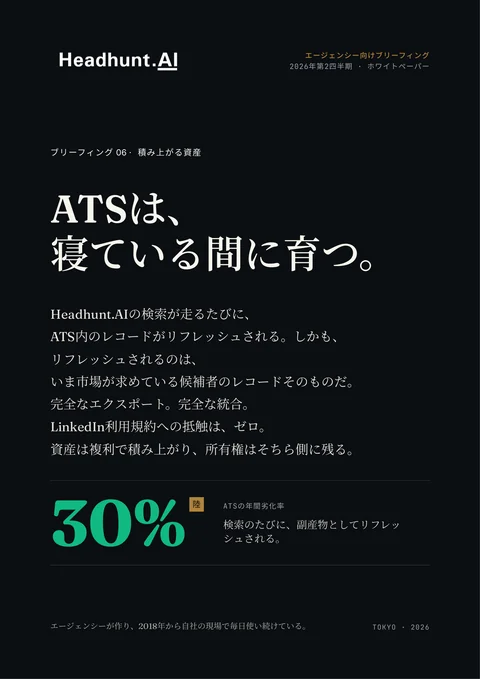
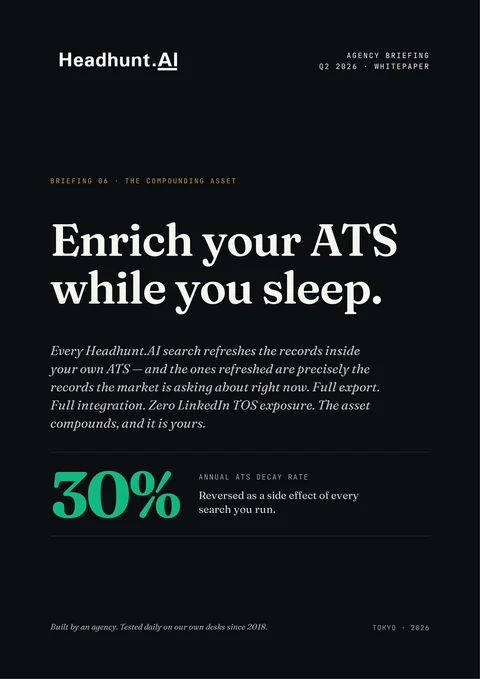
You don’t just buy meetings. You build a living, structured, demand-weighted candidate database — and it is yours.
02Most agency ATS records are graveyards.
Most agency principals know their ATS is dirty. Most underestimate by how much. The published industry numbers are uncomfortable, and they apply across every CRM and ATS that has been live for more than twelve months. Your stack does not exempt you.
Sources: Crelate ATS/CRM analysis 2026; HeyMilo staffing database research 2026; TalentRiver ATS staleness analysis 2026.
Compounded forward, the math is brutal. A 50,000-record ATS untouched for three years has roughly half its records pointing at a stale title or a wrong employer. The candidate is still there, somewhere — but the record cannot reach them. So recruiters do what every recruiter does: they start a fresh external search for every new role and ignore the ATS entirely.
You pay twice for every candidate. Once when you sourced them. Again, eighteen months later, when you re-source them because the record went stale.
03Refresh as a side effect. No project. No team.
Most ATS enrichment vendors sell this as a project. You schedule it. You scope it. You allocate budget. Six months later you have a one-time clean database that immediately starts decaying again. Headhunt.AI handles enrichment differently — as a side effect of work the recruiters were already going to do.
The four-step loop, on every search:
-
Score the ATS pool against the role.
Every search runs against two pools: your existing ATS (imported as a CSV — direct integrations to ATS, CRM, and workflow tools are on our roadmap) and the 4M+ Japan profile database. Both score against the same role criteria. No data migration; the ATS stays where it is.
-
Cross-check each ATS record against the live database.
For every candidate the system pulls from your ATS, it looks up the same person in the live profile database. New title? New employer? New tenure? Anything that has changed since the record was last touched.
-
Write the changes back, field by field, with provenance.
Updated public-profile fields flow back into the ATS in place. Each change carries a provenance flag — what changed, when, from where. Phone numbers, emails, and other private contact fields you already own are preserved untouched.
-
Surface the candidate to the recruiter.
The candidate now appears in the ranked list with current information. The same enrichment that made the ranking work made the underlying ATS record more valuable for every future search.
The cleanup is not the project. The cleanup is the residue of work the recruiter was already going to do.
04The records refreshed are the ones with demand.
This is the part most agencies miss when they think about ATS enrichment. Bulk re-enrichment treats every record as equally valuable. It is not. Most records in any agency ATS are inert — the candidate is not a fit for any current open role and will not be for the foreseeable future. Spending budget to refresh those records is wasted budget.
Headhunt.AI inverts this. The records that get refreshed are exactly the records that surface inside an active candidate search — which means they are exactly the records the market is currently asking about. Not at random. Not in bulk. Demand-weighted, role by role, day by day.
If your bilingual finance practice is running hot in Q1, the bilingual finance records get refreshed. If commercial sales is running hot in Q2, those records get refreshed next. The enrichment work tracks the live market signal coming through your own desk. Put another way: every search is a vote on which records inside your ATS deserve attention right now. Headhunt.AI counts those votes and acts on them. Dead-weight records sit untouched and out of the way. The records that matter get cleaner every time the market re-confirms they matter.
Bulk enrichment treats every record as equal. Demand-weighted enrichment treats every record as exactly as valuable as the market says it is.
05Each search makes the next one better.
The first time Headhunt.AI runs against your ATS, it scores stale records and refreshes the ones that surface. The second time, it scores cleaner records, finds them faster, and refreshes whatever has changed since. Inside six months of normal operating tempo, the working surface of your database is current to within weeks rather than years.
What compounds, on the same desk: Search quality — cleaner records score more accurately, edge-case mismatches drop out, the ranked list gets sharper search by search. Recruiter trust — when the ATS shows the candidate’s current employer, recruiters start to use the ATS again; the graveyard becomes a working file. Re-engagement — industry analysis indicates 46% of sourced hires now come from rediscovered candidates already in the ATS, up from 26% in 2021.
Re-engagement statistic: HeyMilo industry research, 2026. Compounding databases are now the largest single source of placements.
None of this requires headcount. None of it requires a one-time project. None of it requires data migration. It is an emergent property of running searches you were going to run anyway — the value compounds without anybody owning it as a workstream.
Your ATS goes from a graveyard you stopped trusting to a working file your recruiters open first. That shift, by itself, is worth the price of admission.
06Cleaner records. Sharper everything.
The Headhunt.AI value reported in Briefing 08 was scoped to one workflow: AI-driven candidate sourcing. The compounding-database value extends to every other system that touches your ATS — and most agencies have at least four.
BD. "Last year I placed a Director of Engineering at Company X. Where is she now?" If the record is current, the call is warm. If the record says she’s still at Company X two years later, the call is wrong before it starts.
Marketing. Newsletter segments, event invites, nurture sequences — all break when titles and employers go stale. A bilingual VP-Finance newsletter does not land if 30% of the list is no longer in finance.
Future AI. Whatever next-generation matching tool you adopt in 2027 will only be as good as the records it ingests. Garbage-in still applies to AI in 2027 the same way it applied to BI in 2007.
M&A. Acquirers price agency books on database quality. A current 50,000-record ATS underwrites a different valuation multiple than a stale one with the same record count. The difference shows up on the closing wire.
Recruiting tooling is going to keep changing. The platforms that exist in 2027 will not be the platforms that exist today. But whatever you adopt next, it inherits what you built. The data flows out of your ATS in standard formats. There is no migration tax. There is no "but the new tool needs us to re-collect everything" conversation. The substrate is current and structured before the new tool arrives.
The substrate compounds. The substrate is portable. The substrate is the part that is still here in 2030, regardless of what tools came and went.
07LinkedIn is no longer a safe place to build.
There is one obvious objection to everything in this brief. Most agencies have built a parallel data layer outside the ATS — a Sales Navigator account, a few browser extensions, a scraper or two, a third-party enrichment service that pulls fresh titles off LinkedIn. If that workflow is going to keep running, why does the ATS layer matter?
It matters because the parallel layer is no longer reliable. The 2025–2026 enforcement timeline is unambiguous, public, and accelerating.
Jan 2025: LinkedIn v. Proxycurl filed. Federal lawsuit in N.D. Cal. The complaint alleged hundreds of thousands of fake accounts used to scrape millions of profiles. Proxycurl was the unofficial LinkedIn API, with roughly $10M in annual revenue.
Mar 2025: Apollo.io and Seamless.AI removed. Both lost their official LinkedIn Company Pages. No public lawsuit; just deplatforming.
Jul 2025: Proxycurl shuts down. Permanent injunction requires deletion of all scraped LinkedIn data. The injunction is enforceable against Proxycurl’s customers — every agency that bought from them inherits the legal exposure.
Oct 2025: LinkedIn v. ProAPIs filed. A second federal scraping suit alleging millions of fake accounts and customers paying up to $15,000 a month. The pattern is now clearly repeating.
2025–26: "BrowserGate" surfaces. A LinkedIn fingerprinting script scans for over 6,200 browser extensions per page load — up from ~2,000 a year earlier. LinkedIn confirmed in writing it uses the data to restrict accounts.
Sources: LinkedIn news, BleepingComputer, Bloomberg Law, Social Media Today, court filings (N.D. Cal.).
It is tempting to read these stories as "LinkedIn sues vendors" — somebody else’s problem. The fingerprinting script LinkedIn now runs is looking at your recruiters’ browsers, not just at scraping vendors. If a recruiter has the wrong extension installed, LinkedIn can detect it on a normal session and restrict the account. Eight years of connections, conversations, and saved leads, gone in an afternoon. The relevant LinkedIn User Agreement language (Section 8.2) prohibits "crawlers, browser plugins and add-ons, or any other technology" that scrapes the service. The enforcement section survives termination. Once the bell is rung, you do not get to unring it.
LinkedIn is now actively scanning recruiter browsers. The risk is no longer theoretical — it is in the network log on every session.
08Zero TOS surface area. By design.
This is an architectural claim, not a marketing one. Headhunt.AI was designed from day one to require zero contact with LinkedIn. A tool that exposes the recruiter’s account to LinkedIn enforcement is not a tool any agency principal can responsibly deploy.
What Headhunt.AI does: sources from a public-data profile database that does not require LinkedIn login. Reads your ATS via CSV upload today; direct integrations are on the roadmap. Runs every search server-side — no recruiter browser involvement. Drafts scout mail content that your team reviews and sends through your own email on your own domain.
What Headhunt.AI never does: log into LinkedIn (ever, with any credential). Install or require any browser extension on a recruiter’s machine. Use Sales Navigator cookies, sessions, or saved-search data. Touch LinkedIn at runtime in any way detectable by the fingerprinting script.
The same posture that protects your recruiters’ accounts is what makes the platform durable across enforcement updates.
If you cannot describe in one sentence how your sourcing tool stays clear of LinkedIn’s TOS, your recruiters’ accounts are the collateral.
09Six honest answers.
Six questions principals ask once they hear "your ATS gets refreshed for free, and the asset is yours to keep." Each gets a direct answer, not a deflection.
"What ATS systems does Headhunt.AI work with?"
Any ATS that can export to CSV — which is effectively all of them. The current workflow is: export your ATS as a CSV, upload to Headhunt.AI, get scored results back, re-import the enriched data into your ATS. Direct API integrations to specific ATS, CRM, and workflow tools are on our roadmap; we announce each one as it ships.
"Writing back to my ATS makes me nervous. What if the AI overwrites a field I care about?"
The default posture is conservative. We write back only public-profile fields — current title, current employer, current tenure, public career signals — and we tag every change with provenance, so the recruiter can see exactly what changed and revert if needed. Your private contact data, your interview notes, your custom fields — all left untouched. You can also run write-back in dry-run mode for the first month and verify field-by-field before turning it on.
"What if I leave Headhunt.AI in two years? Do I lose the enrichment work?"
No. The enrichment lives in your ATS, not on our servers. The records were updated in place. If you cancel tomorrow, the cleaner records stay where they are — current titles, current employers, current career signals, all written back. You bought ranked lists; you kept the underlying database. That is the whole point of the architecture.
"Where does the public-profile data come from, if not LinkedIn?"
From the open public web. The 4M+ Japan-focused profile database is built primarily from public LinkedIn data through commercial licensing arrangements with global data providers, with additional public social signals from X (formerly Twitter), GitHub, Facebook, and Instagram layered in where candidates have visible activity on those surfaces. All of it is publicly accessible data that does not require authentication and does not require violating any platform’s terms. The relevant U.S. precedent — hiQ Labs v. LinkedIn, the Bright Data wins against Meta and X — establishes that scraping publicly available, non-logged-in data is legally distinct from credential-based access. We work entirely on the legal side of that line.
"My recruiters trust their LinkedIn workflow. Why would they switch?"
They do not have to. Headhunt.AI runs in parallel; it does not replace anybody’s LinkedIn account. The point is not to take LinkedIn away from the recruiter. The point is to refresh your ATS as a side effect of the searches the recruiter is already running, so the database stops decaying. Whatever the recruiter chooses to do on LinkedIn separately is their choice — but the agency’s asset stops depending on it.
"This sounds like a long-term play. I am running a quarterly business."
It is both. The compounding asset is the long-term case. The 17.2× ROI on credits documented in Briefing 08 is the quarterly case. You do not have to pick one. The credits buy you meetings this quarter; the searches refresh your ATS while doing it. The economics work in 90 days; the asset case lands in 24 months. Both are true at the same time.
The compounding asset is not the alternative to the quarterly ROI. It is the residue the quarterly ROI leaves behind.
10A test you can run this week.
Everything in this brief is theory until it is on your own desk against your own ATS. The test is the same one offered in Briefing 08 — but the question you ask afterward is different.
Buy a ¥75,000 credit pack. Connect to your ATS. Run one open role. Every ATS record that surfaces gets cross-checked against the live database and refreshed in place.
Three questions to ask afterward:
-
Sample fifty ATS records that surfaced.
Compare against the candidate’s actual current title and employer. Count how many were correct before the search; count how many are correct after.
-
Sample fifty ATS records that did not surface.
These are the records the market is not asking about — and the records Headhunt.AI did not waste a refresh on. The work tracked the demand signal.
-
Ask your most senior recruiter one question.
"If we ran this for a quarter, would you start opening the ATS first instead of LinkedIn?" If yes, you have your scaling case.
The pilot produces candidates — and a delta on your ATS. Measure both.
11The honest take.
The question this brief leaves with the principal is not really "should I refresh my ATS." It is a different question. It is whether the asset that takes ten years to build — a current, structured, demand-weighted candidate database that your recruiters trust — is going to be sitting on your balance sheet or somebody else’s, in 2030.
The 2025–2026 LinkedIn enforcement record settles one part of the answer. The asset cannot live inside a walled garden you do not control. Account-level deplatforming is no longer a hypothetical. The recruiters who rely on extension-based workflows are one update cycle away from losing eight years of connections, conversations, and saved searches in an afternoon.
The other part of the answer is operational. The agencies that will own clean, current, exportable databases in 2030 are the ones that started compounding the asset in 2026 — passively, as a side effect of normal sourcing work. The ones that wait are the ones still talking about "our data is dirty" in 2030, the same way they were talking about it in 2018.
These systems are the worst they will ever be today. The pace of improvement in AI is not linear — invest now to stay ahead of your competition, or fall behind.
This is uncomfortable to read. It is more uncomfortable to act on. Doing nothing is a decision, the same as any other. It just looks more like the present, which makes it feel safer than it is.